
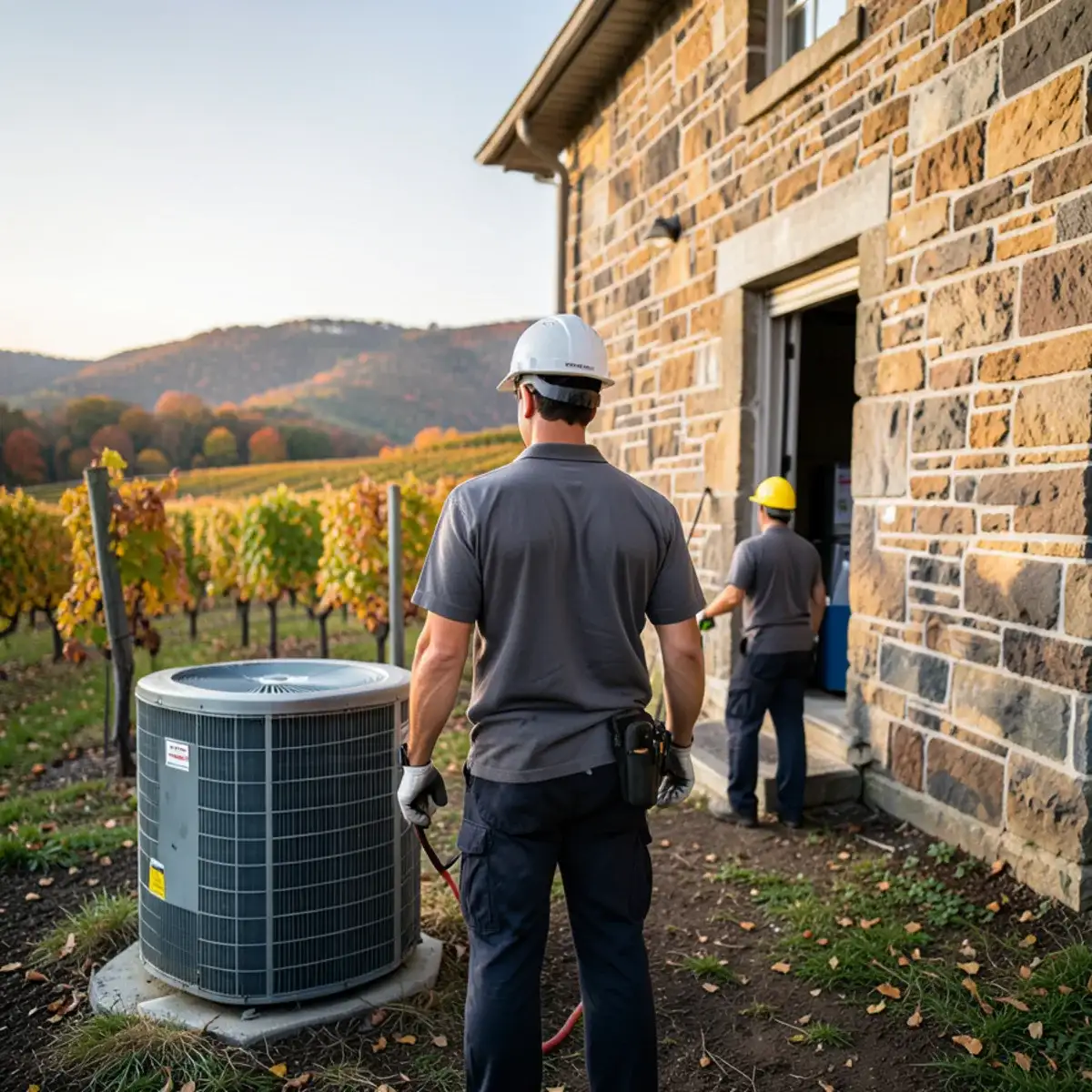
Commercial HVAC
Winery and Tasting Room HVAC in Hermann, MO
Winery and tasting room HVAC in Hermann covers two jobs that pull in opposite directions: cooling a crowded room fast, and holding a cellar steady for months without drying it out. The winemaker sets the targets. The HVAC work is holding them, and this page sets out what that involves.
- 4.7 on Google(15 reviews)
- Serving Hermann since 1998
- Office at 124 E 10th St
Winery temperature control: the published targets
Start from the published numbers, then let the winemaker adjust them. This table shows what extension and building science sources say, and what each one means for the mechanical work. Hermann has been a federally recognized wine region since 1983, and the buildings involved can be anything from a cool stone cellar to a metal shed that heats up by noon.
| Space or stage | Published guidance | What it means for HVAC |
|---|---|---|
| White fermentation | At or below 59°F (Penn State Extension) | Tank cooling is the main tool, and the room should not fight it |
| Red fermentation | 68°F to 86°F (Penn State Extension) | The room must shed heat and carbon dioxide |
| Runaway fermentation | Yeast inhibited near 95°F (Virginia Tech) | Cooling failure at this stage is a real loss |
| Barrel cellar | Around 55°F, 80% to 90% humidity in one French cellar (Building Science Corporation) | Steady and damp, the opposite of normal AC |
| Barrel humidity floor | Under 60%, water leaves and alcohol rises (Virginia Tech) | A dry room changes the wine |
| Bottle storage | 55°F at 70% humidity, about the most corks tolerate (Building Science Corporation) | Humidity needs a ceiling too |
| Cold stabilization | Tanks at 26°F to 28°F (Wines and Vines) | Glycol process work, not room air |
Need Winery and Tasting Room HVAC?
Our office is open Monday to Friday, 8 AM to 4 PM. Call and we will sort out the next step.
Winery and tasting room HVAC risks
Three risks separate this work from an ordinary commercial job.
Drying the barrels. Virginia Tech's enology notes warn that air movement from fan coil units cooling an above-ground barrel room dries barrels and raises evaporation, and that adding humidity then brings cost and problems of its own. Earth-contact walls can remove the need for cooling altogether, so use the building first.
Mold and damp assemblies. Building Science Corporation reports mold is common in barrel cellars at high humidity. Moisture moves through walls in both directions across the seasons, so insulation and vapor control belong in the plan before any equipment does.
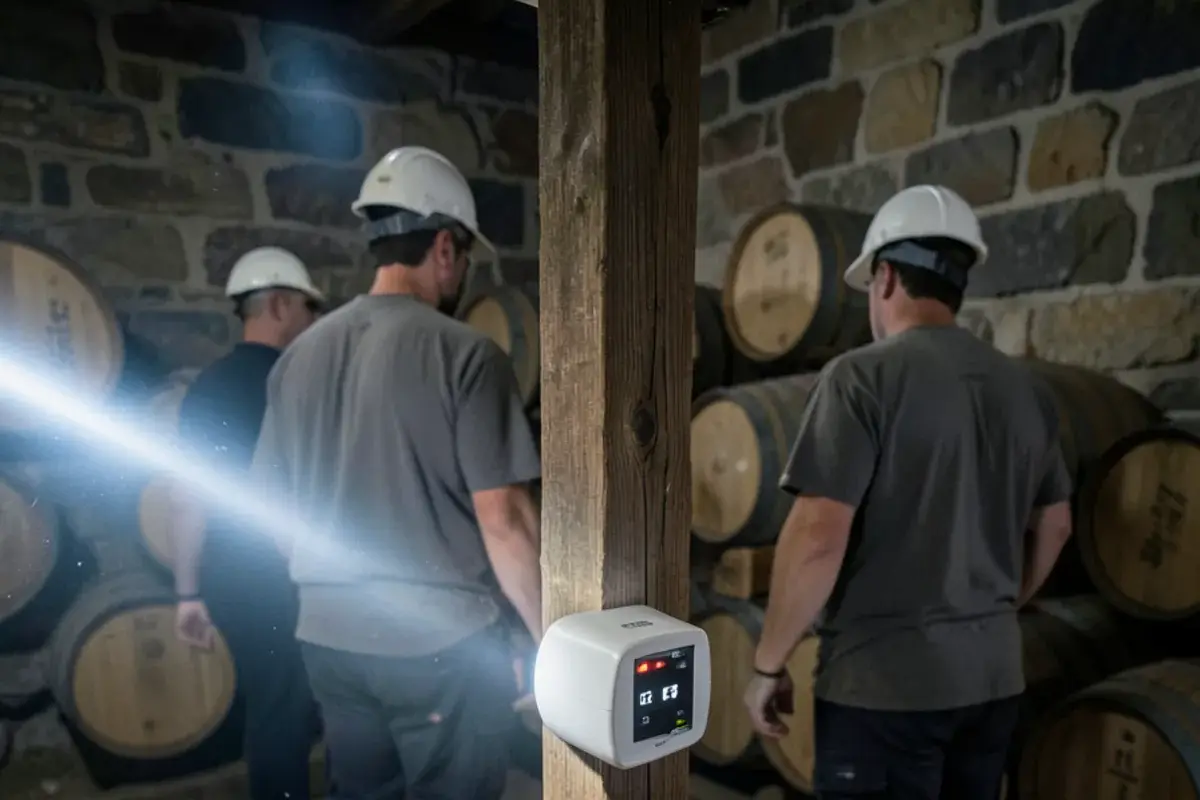
Carbon dioxide. This is the risk that can kill someone.
NIOSH lists 5,000 ppm as the 8-hour limit, 30,000 ppm for short-term exposure and 40,000 ppm as immediately dangerous. An Ontario labor alert describes a fatal case in an unventilated basement during wine fermentation, so exhaust, replacement air and alarms belong in the design.
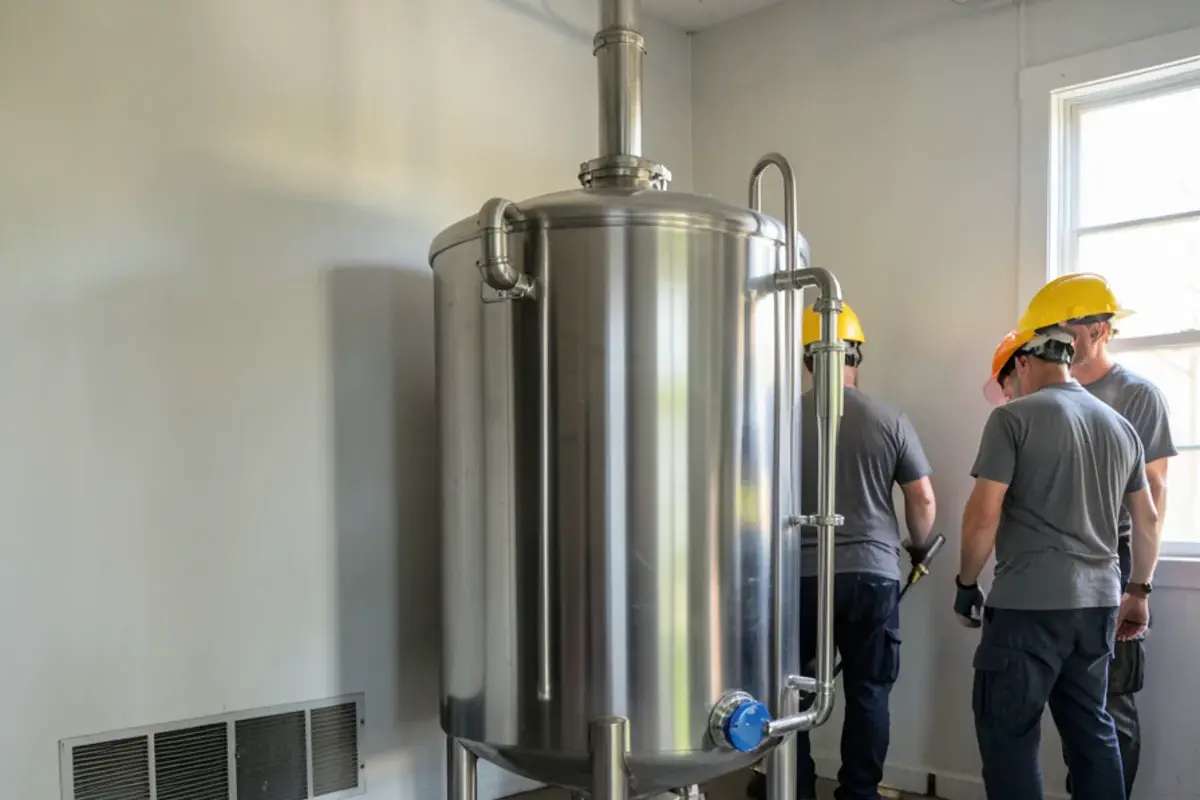
How should tasting room AC and event space HVAC be sized?
Size for the Saturday, not the Tuesday. A tasting room can run half empty all week and then carry a tour group, an open door and a bar of warm bodies. Hermann's Maifest (third weekend in May) and Oktoberfest (first four weekends in October) add the kind of crowd that shows up every shortfall at once.
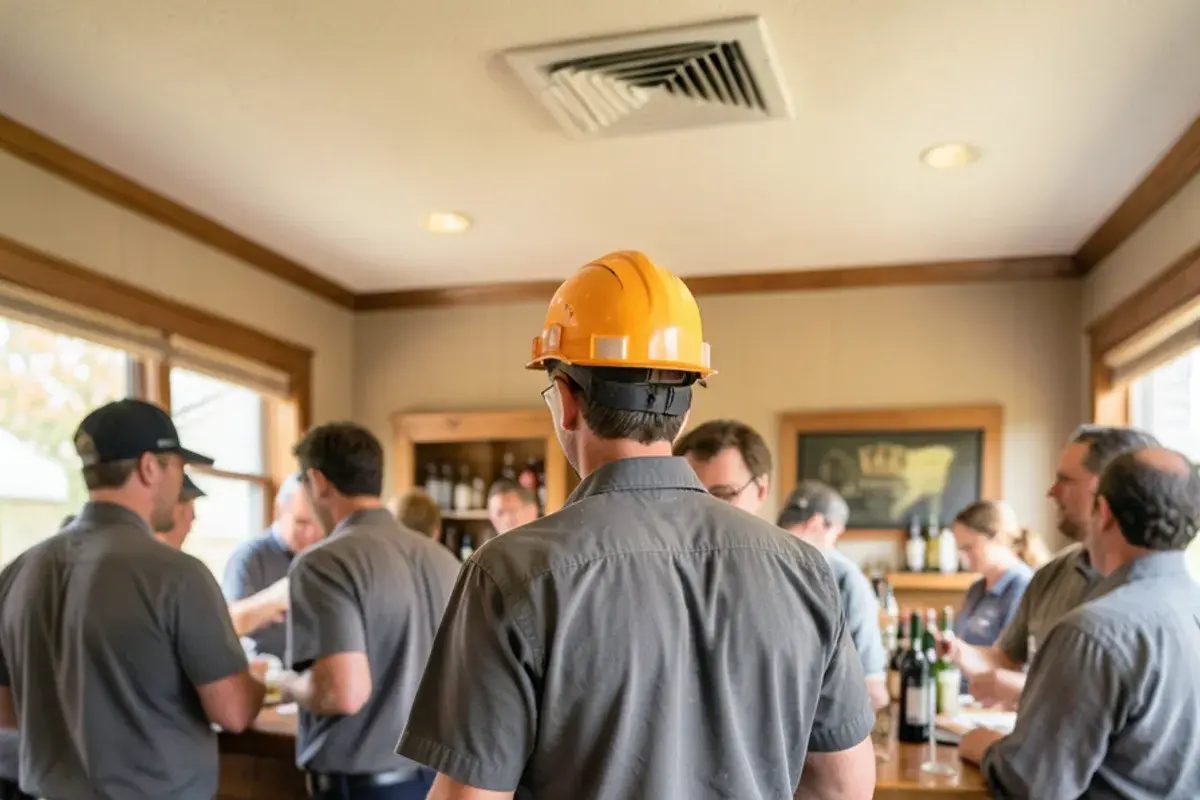
Crowds also need outside air, not only cooling. ASHRAE 90.1-2019 calls for demand control ventilation in spaces over 500 square feet at 25 or more people per 1,000 square feet, on systems with certain controls. Your locally adopted code may differ, so ask the city or county which edition applies before design starts.
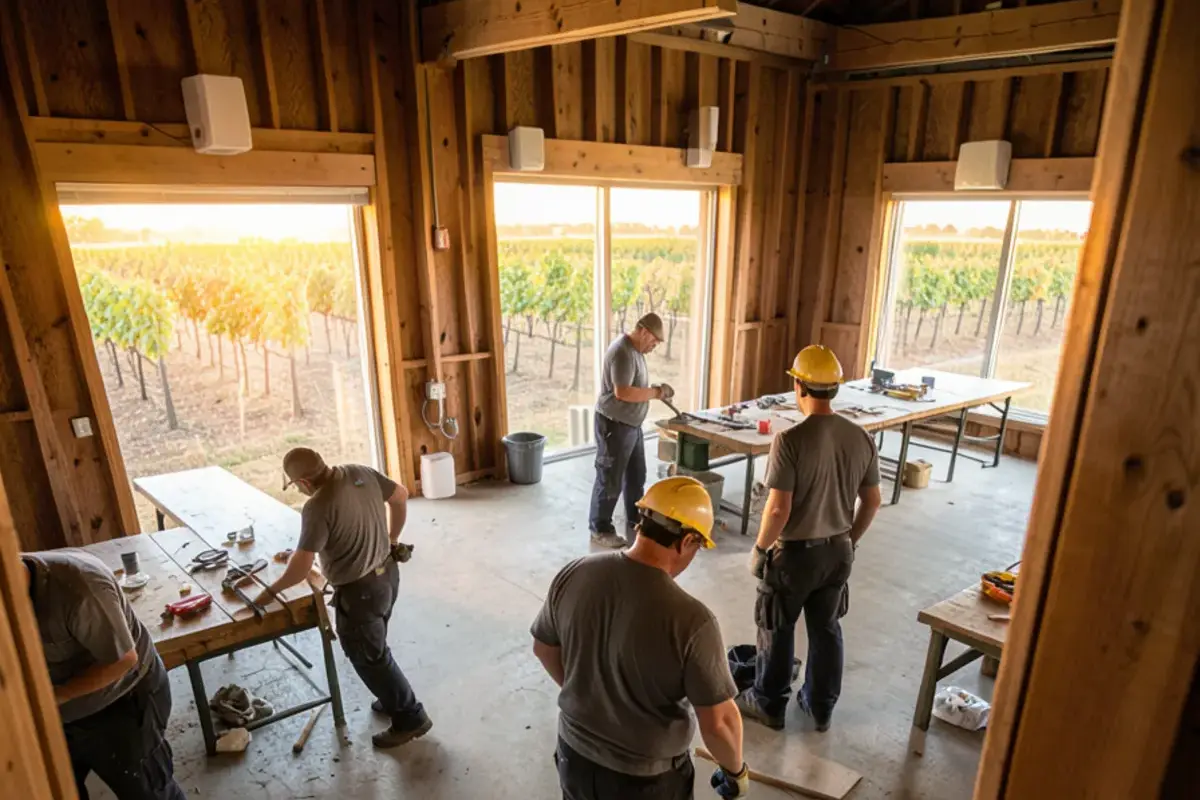
Barns and converted halls bring their own problems: high ceilings, no ductwork and big doors. Zoned ductless systems often fit. Older masonry buildings may also need rooftop units or quiet interior equipment.
Bed and breakfasts sit in the same hospitality family, with a different priority: quiet and room-by-room control. Our bed and breakfast HVAC article covers it in detail.
What is included in winery HVAC work
The line between room air and process cooling decides who does what.
- Included: room heating and cooling, tasting room and event space systems, ductless zones, ductwork and airflow, outside air, exhaust and makeup air for fermentation rooms, and seasonal maintenance.
- Planned with others: humidification, CO2 monitoring and any safety sign-off, along with the winemaker and your safety adviser.
- Not HVAC: glycol chillers, tank jackets and cold stabilization systems are process refrigeration. Kitchen walk-ins and bar coolers are also refrigeration.
How the work runs, from walkthrough to records
- We walk each space with the winemaker or owner and record the targets in writing.
- We note construction, sun exposure, earth contact, equipment and crowd size.
- We log temperature and humidity before changing anything, where time allows.
- We propose the work, explain the trade-offs and quote it before starting.
- We schedule around crush, bottling and events.
- We install or repair, then verify readings at the barrels, not only at the thermostat.
- We leave records of settings, readings and equipment.
Keep those logs. A dated temperature and humidity record helps a winemaker explain a problem lot, and it shows whether equipment is drifting. Permits are local: even an equal-size swap commonly needs a mechanical permit in Missouri, per the Missouri HVAC Authority. Whether the Hermann Historic District reviews visible equipment is unconfirmed, so check with the city first.
Missouri has no statewide HVAC contractor license as of late 2026, so any registration question also goes to the city or county. Tell that office if a barrel room is becoming a tasting room or event space, because a change in how many people use a building can change what it asks for ventilation. Refrigerant work on cellar units still needs EPA Section 608 certification.
What sets the cost of a cellar or tasting room job?
Room size, insulation, humidity control and access set the price, and a cellar job is priced differently from an ordinary comfort job. We have no reliable published price for winery work, so we will not quote one here. Two anchors help: Nears.me lists ductless at $2,000 to $5,000 a zone, and Angi (2026) has St. Louis market labor at $125 to $150 per hour. Neither figure is our price, so ask for a clear, upfront quote on your rooms.
Why Brian Grannemann Services for hospitality HVAC
- Hermann has been our base since 1998, so the valley's humidity and old masonry buildings are familiar ground.
- Heating, cooling, electrical and plumbing all appear on our trade list, which helps where drains, power and ventilation meet.
- Donna M. wrote that Brian uses every safety precaution, which is the right habit around fermentation gas.
- We say plainly where our work stops, as the glycol line above shows.
Hospitality properties run from Hermann through Rhineland, Berger, New Haven and Marthasville. Call (209) 563-1270 to set a walkthrough, and bring the winemaker's targets. Regular upkeep is covered on our commercial maintenance page.
Calling is fastest
Ask about Winery and Tasting Room HVAC
Calling gets you an answer sooner, especially if the house is cold or hot right now. If it can wait, send the details and our office will get back to you during business hours.
Smell gas? Do not use this form. Leave the building and call from outside.
What customers say on Google
4.7 on Google(15 reviews)“Hot water heater went out and Brian worked with us to help us find the correct replacement parts, and the repair process. He is knowledgeable, reliable and very responsive. He came out saw that we needed one more possible part and said he wouldn’t charge us labor until the water heater was up and running. We got the right parts he came out to install and had us up and running! We will definitely rely on him again for any future issues with HVAC, water heater, and or plumbing issues! It’s so nice to have hot water again!”
“I can’t say enough good about Brian and his company. They are my go to guy’s. I’ve had them work for me about a half dozen times now. No need to look elsewhere. They are fair and responsive to your needs.”
“Brian consistently shows up when promised, completes the work correctly the first time, and provides quality products. I cannot recommend him more highly.”
Good to know
Winery and Tasting Room HVAC questions
What temperature should a wine barrel room be?
Ask your winemaker first, because the target depends on the wine. As a reference, Building Science Corporation describes a French barrel cellar at around 55°F and 80% to 90% relative humidity. The HVAC job is holding that steady, since swings matter as well as the number itself.
Can a regular air conditioner handle wine cellar cooling?
It can cool the room, but it was built for people, not barrels. A standard coil pulls moisture out and moves plenty of air, and Virginia Tech enology notes warn that fan coil airflow dries barrels. Equipment choice, airflow and humidity need to be planned together.
Does a fermentation room need its own ventilation?
It should have a plan. Fermentation releases carbon dioxide, and Ontario's labor ministry advises ventilating fermentation areas mechanically to the outdoors, replacing that air and fitting CO2 monitors with audible alarms. NIOSH sets the short-term exposure limit at 30,000 ppm. A winery's safety adviser should sign off on the design.
Do you service glycol chillers on wine tanks?
Ask us with the equipment details in hand. Glycol chillers and tank jackets are process refrigeration, not room HVAC, so some of that work belongs to a specialist. We will tell you plainly whether a given unit is ours to work on, and who to call if it is not.
Why does my tasting room get hot only when it is full?
Because people are the load. A system sized for an empty room in a Hermann July can fall behind once a tour bus arrives and the doors keep opening. A check starts with airflow and refrigerant, then whether the unit has the capacity for the crowd you actually get.
When is the right time to schedule work around harvest?
Before crush, and well clear of the festival weekends. Ask your winemaker for the likely dates, since they shift by vintage and variety. Pre-season checks on cooling and ventilation fit the slower weeks of summer, and tasting room work suits a weekday morning.
Sources
- Penn State Extension, Wine Production
- Virginia Tech, Enology Notes 158 (Zoecklein)
- Virginia Tech, Enology Notes 141 (Zoecklein, 2008)
- Building Science Corporation, BSI-010: Wine Cellars
- NIOSH Pocket Guide, Carbon dioxide
- Ontario Ministry of Labour alert, Hazardous carbon dioxide concentrations in wine making
- ASHRAE 90.1-2019 Addendum b, demand control ventilation
- Wines and Vines Analytics, Tartrate stabilization methods
- Angi, HVAC repair costs in St. Louis (2026)
- Wikipedia, Hermann AVA
- Wikipedia, Hermann, Missouri (festival weekends)
Where we handle winery and tasting room hvac
- BergerSmall town on the Berger Bottom along Route 100.
- New HavenRiverside town with historic homes.
- RhinelandDirectly across the river, with flood-aware rebuilt homes.
- MarthasvilleKaty Trail town with older homes.
- MorrisonRoute 100 community with older farmhouses.
- Montgomery CityCounty seat with older housing.
- Montgomery CountyFarms and small towns north of the river.
- Osage CountyRural homes and farms west of Hermann.
- Cole CountyCapital-area homes and offices.
Read next
Based at 124 E 10th St in Hermann, we work across Gasconade County and the towns around it, including Owensville, Morrison, Rhineland, Berger. See all the areas we serve.
Winery and Tasting Room HVAC from a Hermann company
A Hermann company since 1998. Tell us what is going on and we will tell you what happens next.
- 4.7 on Google(15 reviews)
- Serving Hermann since 1998
- Office at 124 E 10th St